Friday, 30 March 2012

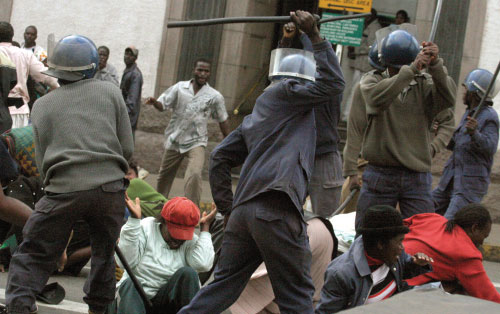
What next in the Zim torture case in SA?

Here's my latest on the case. You can also hear full interviews with SALC's Nicole Fritz and the ZEF's Gabriel Shumba on Sunday on Southern Africa Focus www.swradioafrica.com

Activists ‘hopeful’ ahead of Zim torture ruling

Nicole Fritz, Executive Director of the Southern Africa Litigation Centre
By Alex Bell
30 March 2012
The activists who led a landmark legal challenge in South Africa this week have expressed hope for a favourable ruling, expected in the coming months.
The case, which calls on South Africa to honour its international legal obligations and investigate incidences of torture in Zimbabwe, came to an end in the Pretoria High Court on Thursday. Presiding Judge Hans Fabricius reserved ruling on the matter, but a judgement is expected soon.
The Southern Africa Litigation Centre and the Zimbabwe Exiles Forum filed an application to the court earlier this year hoping to overturn a decision by South Africa’s National Prosecuting Authority (NPA) and the police not to investigate high level Zim officials linked to state sanctioned torture in 2007.
Their case is based on a dossier detailing the attack on MDC members in 2007, which was handed to the NPA in 2008. But a formal investigation was never launched.
The court challenge this week argued that South Africa does have a legal obligation to investigate these crimes, because it is a signatory to the Rome Statute. The legal team representing the Litigation Centre and Exiles Forum argued that the NPA and the police had failed in their duties by not instituting an investigation, because Zimbabwean victims have no way to get justice back home.
The Litigation Centre’s Nicole Fritz told SW Radio Africa on Friday that she was pleased with how the case progressed this week, explaining that even Judge Fabricius appeared critical of how the State had handled the issue.
“It would appear that Judge Fabricius is aware and very troubled by the fact that Zimbabwean torture victims have no rights and he seems to be upset by their plight,” Fritz said.
She added: “We seem to have a receptive judge and I’m delighted by what has been the court reaction, so I am confident of a favourable ruling.”
Fabricius appeared particularly critical of the State institution’s arguments that political obligations outweighed their legal obligations, saying he would “through his hands up in horror” if human rights are bested by politics.
Gabriel Shumba, a torture survivor and director of the Exiles Forum, told SW Radio Africa that he is also hopeful that this attitude of the judge will result in a favourable ruling.
“We have reason to hope for the best and reason to be positive,” Shumba said, adding: “This case will set a precedence for combating impunity in Southern Africa.”
To contact this reporter email alex@swradioafrica.com

Tuesday, 27 March 2012

Landmark Zim torture case in SA posptoned

A landmark case centering around crimes against humanity in Zimbabwe will only get under way in a South African High Court today after it was postponed Monday. Here's my report on the situation:


‘Extraordinary’ twist in SA, Zim torture trial

Nicole Fritz, Executive Director of SALC
By Alex Bell
26 March 2012

There’s been what has been described as an ‘extraordinary’ twist in a landmark court case in South Africa, which will urge the authorities there to investigate and prosecute high level Zimbabwean officials accused of crimes against humanity.

The case, filed by the Southern African Litigation Centre (SALC) and the South Africa based Zimbabwe Exiles Forum was meant to get underway on Monday. The groups are asking the High Court to review and set aside a decision made by South Africa’s National Prosecuting Authority (NPA) and the police not to investigate Zimbabwean officials linked to acts of state-sanctioned torture. This followed a police raid on the headquarters of the MDC in 2007.

But the start of the case was postponed to Tuesday after “stunning” new testimony from one of the key respondents. Anton Ackermann, the head of the NPA’s Priority Crimes Litigation Unit, last week lodged his testimony before the court – indicating that he had recommended an investigation, had disagreed with the police’s reasons for not pursuing the case and had been “manipulated and misled” by both his colleagues within the NPA and the State’s Advocate.

“The contents of Ackermann’s affidavit cast serious doubt over the reasons that the Director of Public Prosecutions and the Police Commissioner gave for not initiating an investigation into these crimes against humanity,” said Nicole Fritz, Executive Director of SALC.

Fritz told SW Radio Africa that Ackermann’s new testimony “also calls into question the very independence and impartiality of the NPA and its prosecutors.”

“Ackermann is in law responsible for the management and direction of investigations and prosecutions of international crimes and he was the original recipient of SALC’s request to initiate an investigation. According to his sworn testimony, he called for a docket to be opened, SALC to be consulted, the Priority Crimes Unit to be approached for guidance and for the docket to be submitted to the NPA for a final decision. None of these recommendations were followed,” Fritz said.

Fritz also explained that Ackermann’s new evidence demonstrates “his attempts to provide his version of events were met with persistent resistance on the part of his colleagues, and even threats.”

In correspondence between Ackermann and the State Advocate Christopher Macadam, Ackermann was warned to “very carefully and seriously consider the implications of including a statement that you were not satisfied… which has very important consequences for both the Applicants and the Respondents. I also believe that the court would be required to make findings on your ethical conduct which could result in further action being taken against you.”

Fritz meanwhile applauded Ackermann’s decision to come forward with this testimony because of the precedence it sets for the rule of law in South Africa. But she warned that Ackermann could now be “punished” for coming forward.

“It is prosecutors such as Ackermann that inspire confidence in the justice system and the rule of law so we really hope this does not happen and the NPA proceeds properly in dealing with this,” Fritz said.
The case will now get underway on Tuesday.

To contact this reporter email alex@swradioafrica.com

Friday, 23 March 2012

Very important case in SA next week

Just a quick note about this VERY important case led by the Southern African Litigation Centre next week:

Here's some background from SALC (http://salcbloggers.wordpress.com/2012/03/23/background-to-mondays-landmark-case-on-crimes-against-humanity-in-zimbabwe-and-sas-responsibilities/)


Background to Monday’s Landmark Case on Crimes Against Humanity in Zimbabwe and SA’s Responsibilities

March 23, 2012


SALC’s case relating to widespread and systematic torture in Zimbabwe — crimes against humanity — which has been five years in the making finally goes to court on Monday. Here’s some background to the case:

Why now?
It isn’t so much that this case has been brought now. This case is five years in the making. The primary events which the dossier, forming the basis of the challenge, chronicles relate to events occurring in March 2007 when Zimbabwean police raided the MDC’s headquarters and detained and tortured scores of activists. Affidavits relating to those events were collected in 2007 and 2008. We submitted our dossier relating to those events and making the case that torture was committed in a widespread and systematic way in Zimbabwe against political opponents of ruling party ZANU PF– hence a crime against humanity — and that South Africa’s Implementation of the Rome Statute Act for the International Criminal Court gave SA authorities powers to investigate and prosecute crimes of persons who were present in SA after committing those crimes (even if they weren’t SA nationals and the crimes had been committed outside SA). We maintained that the Zimbabwean officials named in our dossier as perpetrators travelled into SA on a regular basis and so could be subject to prosecution. We submitted our dossier when we did in the rather futile hope of it having some deterrent effect on the violence that we anticipated would happen after the elections. As you’ll know the post-election violence was of an unprecedented scale.
After more than a year considering our dossier, the prosecuting authorities informed us that the police did not intend investigating the matter. We then began the process of launching a review application before the SA High Court, asking that it review and set aside the decision that had been taken. Litigation is notoriously slow and cumbersome and after many rounds of exchanging legal papers we now finally have our court dates. As it is we think the dates are rather fortuitous — with developments in Zimbabwe suggesting that some of the political authorities are pushing for elections this year in violation of the Global Political Agreement and with fears that violence again will be used to intimidate and harass and there being no obvious domestic attempts to bring the culture of impunity to an end in Zimbabwe — the case, rather than just submission of our dossier, may have some appreciable impact ( the apprehension at least for those committing violence in Zimbabwe that their impunity ends at Zimbabwe’s borders).
What precedent do you hope to set?
As for precedent, the case, if successful, won’t itself usher in investigations and prosecutions but opens the way for these to happen. If the court upholds our arguments, it may order that the prosecuting authorities have acted unlawfully in their treatment of our dossier, that they didn’t give it the consideration required and that their initial decision not to investigate/prosecute is set aside and they must apply their minds anew to our submissions. It would mean that the court would underline the importance of SA’s international obligations vis-à-vis the International Criminal Court, the high principle at stake and the care and importance SA must accord charges of crimes against humanity, war crimes, genocide. It will be the first time a SA court is asked to make a determination regarding SA’s ICC Act and globally would serve to affirm the ongoing importance of universal jurisdiction laws. It will also point to the fact that international criminal justice is not only secured on the international realm but perhaps most importantly within domestic jurisdictions.
What do we expect?
We believe we have a very strong case and so we’re anticipating a positive outcome.

Wednesday, 14 March 2012

What hold does Robert Mugabe have over the UN?

It's a question that gets bandied about quite often in commentary circles, and year after year, as the situation in Zimbabwe plods in circles in the realm of craziness, more people wonder why there has never been a genuinely strong, public indictment of Robert Mugabe and ZANU PF at UN level.


Yes, we all know that the UN is bound by its own reams of diplomatic tape, and I think there are few people who genuinely believe that the UN has much credibility anymore (just read "Complicity with Evil: The United Nations in the age of Modern Genocide" by Adam Lebor). But this does not change the simple fact that the UN is the face of the most powerful nations on earth who have the mandate and responsibility to cry out when things are wrong.


Or so we would like to believe, because believing there is a higher level of authority as outraged as the rest of us mere mortals by the state of the world, makes coping with this state somewhat easier.


So why the silence on Zimbabwe? 


Zimbabwe has slipped off the public awareness radar in recent years, and whether this is a sign that the rest of the world is too focused on the chaos elsewhere or because the fatigue over Zimbabwe's crisis has reached the ultimate point of lethargy, I'm not entirely sure.


But whatever the reason, there should be no excuse, for example, for the UN to ignore Zimbabwe's shocking record of politically motivated rape during election periods. Which is precisely what someone was finally spurned into using a very public platform to say.


Stephen Lewis, the co-director of the international advocacy group AIDS-Free World, last week called the UN out over this silence, calling it ‘unforgivable’ that the plight of Zimbabwe’s rape victims was being ignored. Speaking on International Women’s Day last week at the UN Human Rights Council, Lewis questioned what hold Mugabe has over the UN, that Zimbabwe was left off a ‘Name and Shame’ list of serious sexual violence during elections in different countries. (Read his statement here: http://aids-freeworld.org/Publications-Multimedia/Speeches/Honor-Women-by-Naming-and-Shaming-Zimbabwe.aspx)

This list was the result of a UN resolution adopted in 2010, which has aimed to correct years of impunity for perpetrators of sexual violence and rape around the world. The document has been lauded as one that could change the course of history for the world’s women, by naming and shaming the countries leaders and where possible, the perpetrators of such attacks.

But, as AIDS-Free World’s Lewis (pictured above) discovered when the list was released in January, there was a glaring omission in that Zimbabwe was not mentioned at all. 


I spoke to Lewis this week and couldn't pin down why there is this 'unforgivable' silence from the EU, saying it is likely the attitude of South Africa's leaders that are perpetuating this behaviour, referring to Thabo Mbeki's and (in a lesser sense) Jacob Zuma's respectfulaction-less camaraderie with a fellow freedom fighter.


Referring to Mugabe as a “crazed politician” who has used sexual violence and rape as part of his “strategy in his political apparatus” since the 80s, Lewis said it is a “startling omission” that he is not being ‘named and shamed’ by the UN. He also called the Mugabe regime's behaviour as 'berserk' and 'demonic', and I applaud him for this brutal honesty that so many people are too 'diplomatic' or afraid to voice.


Lewis hopes, as much as I do, that this is the last time that Zimbabwe will be exempt from such a list and I sincerely hope that it is not just in this category that abuses in Zimbabwe will receive such high level blanking. (I won't hold my breath however.)

You can hear my interview with Lewis on my Diaspora Diaries series on SW Radio Africa here:
http://www.swradioafrica.com/podcasts/wordpress/?p=14158

And if you can read the AIDS-Free World report on the campaign of politically motivated rape in Zimbabwe in the 2008 election period here:
http://aids-freeworld.org/Publications-Multimedia/Reports/Electing-to-Rape.aspx