Thanks to the Guardian newspaper for highlighting this insanely important issue:
South Africa's 'secrecy bill'
attracts international condemnation
US
and European countries register concerns about curtailing freedom of the press
at UN human rights working group
·
David Smith in Johannesburg
·
guardian.co.uk, Wednesday
13 June 2012 18.39 BST
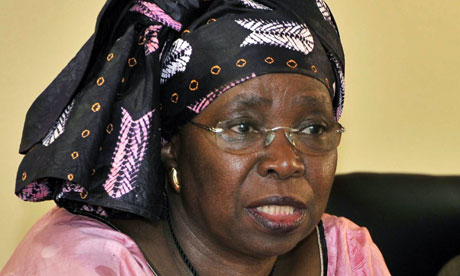
South
Africa's home affairs minister Nkosazana Dlamini-Zuma. Photograph: Jacoline
Prinsloo/AFP/Getty Images
South Africa has received widespread international
condemnation of its "secrecy bill"during
a UN review of the country's human rights record.
The
United States, Canada, Czech Republic, Germany, Norway, Poland, Portugal,
Sweden and Switzerland all expressed concerns that the proposed laws could
threaten media freedom.
The
intervention – the biggest collective stand yet taken by foreign governments on
the issue – was welcomed by activists who oppose the bill, which could make
journalists and whistleblowers vulnerable to prison sentences of up to 25
years.
South Africa's human rights record was
scrutinised by a working group of the UN Human Rights
Commission (UNHRC) in Geneva recently. A draft report of
the meeting shows that Spain "asked about measures adopted to ensure that
the future protection of state information does not curtail freedom of the
press and right to information on possible inappropriate action by public
officials".
Sweden
"noted that the protection of state information bill might lead to
restrictions on media freedom".
Germany
called on South Africa to "safeguard the freedom of the press, through the
abrogation of the protection of information bill".
The
United States urged: "Engage civil society, activists, NGOs and media to
seek common ground on the protection of state information bill."
Canada
recommended that South Africa "ensure that the protection of state
information bill and other statutory measures do not violate the right to
freedom of expression or unduly impede access to public domain
information". Norway said the country should make sure the bill
"fully complies with international human rights law".
Czech
Republic asked South Africa to "reconsider the protection of state
information bill to ensure its conformity with ICCPR (international covenant on
civil and political Rights), in particular by removing excessive penalties for
publication of classified information and the inclusion of a public interest
defence".
Poland
urged South Africa to "continue amending and improving the project of the
protection of state information bill as this law, in the form proposed to the
parliament earlier this year, has the potential to undermine the right to
access to information and freedom of expression under the pretext of national
security and national interest".
Switzerland
recommended: "Amend the draft bill on the protection of state information
so that freedom of press is not curtailed in a disproportionate manner."
Portugal
said: "Consider suspending the enactment of the protection of state
information bill, approved last November."
In
response, South Africa's delegation insisted the bill was not aimed at the
media. "The primary purpose is not to regulate or interfere in any way
with the media or access to information, but seeks to amend current statutes
not consistent with our constitution," it said. "Government has been
very open and has engaged with the media and with civil society. The draft bill
is currently before parliament."
Editors, lawyers, writers
and leading public figures such as archbishop emeritus Desmond Tutu have
previously spoken out against the bill. Some warn that it could lead
to similar crackdowns in other African states.
South
Africa's main opposition party, the Democratic Alliance, said views expressed
at the UN would boost efforts to amend the legislation. Alf Lees MP said:
"We welcome any influence brought to bear that will result in the bill
being amended to make it more acceptable and constitutional."
Noting
South Africa's remarks that bill is not intended to curb the media, Lees
commented: "Whether or not it is the purpose of the bill is debatable. The
fact remains that the bill in its current form still poses a significant threat
to human rights and fundamental freedoms enshrined in the constitution.
"The
concerns raised in the UNHRC discussions provide greater impetus to the
(parliamentary) committee to make further changes to the bill to ensure that it
is brought in line with the constitution."
Debate
on the bill has stalled again this week. A hearing of the ad hoc committee in
the national council of provinces scheduled for Wednesday was postponed
indefinitely. The state security department has rejected ANC proposals to water
down the bill.
·
© 2012
Guardian News and Media Limited or its affiliated companies. All rights
reserved.


No comments:
Post a Comment